Storage : servers and collaborative tools
Storage : servers and collaborative tools
In most common scenarios, data is stored on a computer, an external hard drive or a USB stick, the latter being as convenient as it is risky. Most of the time, users only realise the risk they are facing once the damage has already been done: a computer crash, data being accidentally overwritten, loss or theft…
The use of a server, which presents fewer risks and offers greater storage capacity, is an essential tool for research projects. This centralisation of resources is often complemented by collaborative tools that facilitate the sharing of information amongst members of a project team, particularly when the team is overseen by multiple supervisory bodies.
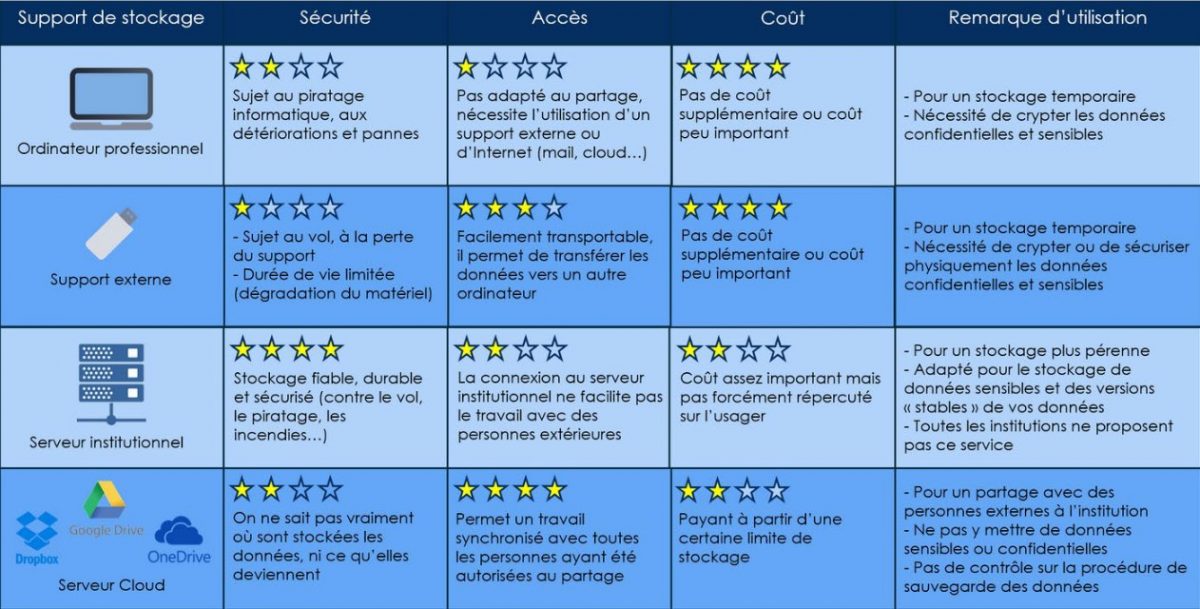
Lyon 1 University, for example, offers a collaborative platform called Box-ng, which is based on NextCloud technology (open-source file-hosting software). Any user with a Lyon 1 account can log in and share files. File sharing works in a similar way to Google Drive, and it is possible to send a link to another user so that they can join a workspace, whilst customising their access rights. The Gricad UMS provides researchers working within the University of Grenoble Alpes with high-performance computing and data processing facilities, a cloud (with virtual servers) and a collaborative work platform.
In addition to traditional institutional servers, secure tools are available online. The EUDAT.eu platform (an EOSC node supported by the European Commission and by its members) offers, for example, a range of online services covering various data management needs, such as storage, search and archiving.
B2Drop allows you to store research data and synchronise it across multiple devices. You can also share data with colleagues or members of a group. It provides 20 GB of storage per user and 2 GB per file. It is intended for use solely with frequently accessed data, for example during a project involving several institutions. There is no metadata associated with the data.