Licenses and Data Sharing
- Which licenses are appropriate for which types of resources?
- Define the intended uses of your dataset
- The practices of funders, publishers and repositories
- Resources
In order to allow other researchers to use your data, whether deposited in a repository or accessible via a publication, it is necessary to establish the terms of use via a licence.
As part of the implementation of the FAIR principles, licensing a dataset helps to ensure compliance with the ‘reusable’ principle by explicitly stating the conditions for reusing the data.
These licences vary in nature and do not all permit the same uses, which is why it is important to understand the practical implications of choosing a particular licence. Most repositories and publishers provide a usage licence for the content they distribute. In fact, granting a license is often mandatory as part of the process of depositing a dataset.
Which licenses are appropriate for which types of resources?
Research Data
Creative Commons Licenses
Creative Commons (CC) licenses are widely used and are the most common choice for research data and scientific publications. The Creative Commons organisation has published and updated them regularly since 2002.
This international non-profit organisation aims to provide legal and technical solutions that promote the sharing of content in the fields of culture, science and education. The organisation is therefore committed to advancing open science. The current version of these licenses is version 4.0.
Assigning a license to a piece of content is a permanent act. Applicable in all countries, Creative Commons licenses comply with French copyright law. They enable authors to specify the permissions they grant.
There are six categories of license, each with terms that are more or less permissive. Pictograms are used to identify these licences and their scope. This diagram (in French) summarises the degree of openness of Creative Commons licenses:
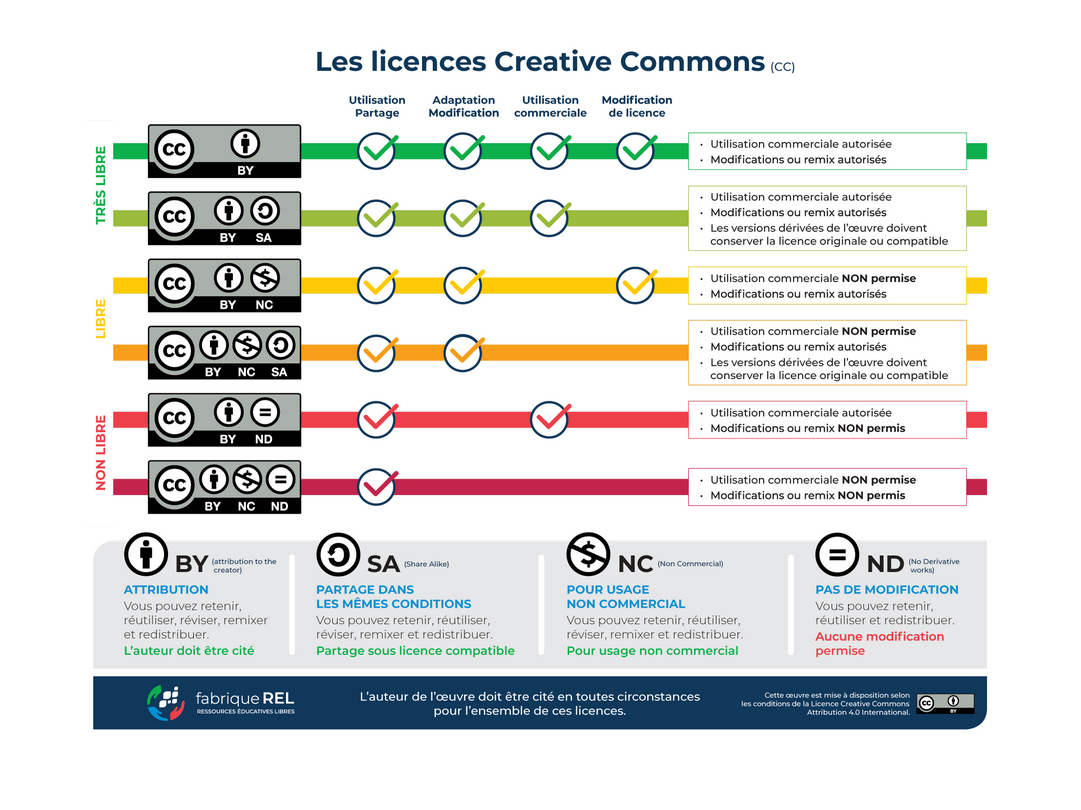
To make the Creative Commons license as clear as possible, it is recommended that you use the relevant logo, specify the license name and provide a link to it. For example: CC BY 4.0 for a work licensed under CC BY 4.0.
You can use the CC license chooser tool to obtain the HTML code for the selected license, and you can find the official logos and attribution text here.
Etalab License
In the context of open data, and to facilitate the publication and reuse of public data, Etalab — a department within the direction interministérielle du numérique (DINUM) that coordinates policy on the publication and sharing of public data — has established the ‘Open Licence’.
This open, free and royalty-free licence authorises the reproduction, redistribution, adaptation and commercial use of data, providing the necessary legal certainty for producers and reusers of public data. Attribution of the data’s authorship is required.
The Open License is compatible with open data licences developed abroad, such as the British government’s Open Government Licence, as well as other international standards (ODC-BY, CC-BY, etc.).
Download links:
- Licence Ouverte/Open License Version 2.0 (PDF) : Version française | Version anglaise
- « Licence Ouverte/Open License » logos : Fichier ZIP contenant les logos de la Licence Ouverte sous différentes couleurs
- GitHub : Licence Ouverte/Open Licence au format Markdown
The Public Domain License
The CC0 (Public Domain Dedication) license enables authors to waive their rights to their work, placing it in the public domain so that others can reuse it without conditions or restrictions (e.g. modification or commercial use).
While it is not mandatory to cite the dataset producer, users are encouraged to do so from a scientific standpoint to identify the source. Therefore, this is the licence that allows for the broadest reuse of datasets.
For more information, read :
Databases
Database protection falls under two different rights: copyright and the “sui generis right of the database producer. Copyright only applies to a database if its structure (model or schema) is considered original; that is, if the arrangement of its elements reflects a choice that ‘bears the imprint of the author’s personality’. This is generally not the case with research databases. The sui generis right protects the investments made by database producers, typically the institution that employs the researcher who creates the database. This right lasts for 15 years after the database is completed. It is therefore recommended that all employers and stakeholders are identified in order to determine each party’s contributions.
The Open Data Commons Open Database License (ODbL) (ODbL) applies to databases. It is a free license that allows for the unrestricted use (including commercial use) of the database. It does not apply to the content (images, text, etc.) within the database, which may be subject to specific licenses (CC BY, CC BY-NC, etc.).
Software and Codes
See page “Licenses and intellectual property”
Define the intended uses of your dataset
It is important to consider the conditions for use, access and exploitation when making a dataset available, in order to assign an appropriate licence to it.
Choose a License
Several criteria must be taken into account:
- Dissemination requirements, such as those for geographic and environmental data (e.g. the INSPIRE Directive), and constraints related to datasets produced within the framework of ZRR or PPST. See Bassinet, A., Bouchet Moneret, F., Bracco, L., & Jouneau, T. (2023, décembre 6). Les données de la recherche produites en zone à régime restrictif. Atelier de la donnée ADOC Lorraine).
- Funding agencies’ requirements or recommendations (see Section 4.1).
- Publishers’ requirements in the case of publication alongside an article (supplementary materials).
- Licences offered by the repository.
- Licences for content included and reused in the dataset.
It is recommended to use a widely adopted license, such as a Creative Commons license.
If in doubt, it is generally possible ask for advice from your institution’s legal department.
Tools are available to help you identify the most suitable license through a series of questions and answers:
- A generic tool: License selector
- For Creative Commons Licenses: CC license chooser
For codes and software:
- choosealicense.com
- Joinup Licensing Assistant, a tool developed by the EU.
Define Access Rights
Beyond licensing, there are various ways to restrict access to your dataset.
- Embargo
Most repositories allow you to delay public access to a dataset. You can specify a publication date and set an embargo period before the dataset is made available. This feature can be useful if you want to publish a dataset and a research article simultaneously. The description page for each repository in the physics and chemistry repository directory available on DATACC indicates what type of embargo is possible (duration, conditions, etc.).
- Access on request
Access can also be set up on a request-only basis. When a request is made to view the dataset, an email notification is sent to the submitter. This mechanism is useful for datasets containing high-value and/or sensitive information.
- As part of a peer review process: private URL / anonymous private URL.
Most subject-specific and generalist publishers (IOP, RSC, AIP, Elsevier, Springer, EGU, etc.) now require authors to include a data availability statement in their articles. This statement may be a condition of publication. It is often requested as early as the article submission stage. Reviewers may also request access to the data when they deem it necessary whilst assessing the manuscript. As a reminder, datapapers and datanotes are subject to the same peer review process as a standard article.
Where datasets are to be peer-reviewed on a blind basis, some repositories allow users to create a private URL for anonymous access.
Please note: some data warehouses carry out peer review of the data. This is the case, for example, for HEPdata.
The practices of funders, publishers and repositories
Funders‘ practices
CC licences and open science
The CC BY licence encourages the widespread reuse of data. It is therefore consistent with the principles of open science.
Please note : la Directive (EU) 2019/1024 of the European Parliament and of the Council of 20 June 2019 on open data and the re-use of public sector information specifies, with regard to research data and in accordance with the principle of ‘as open as possible, as closed as necessary’, that data resulting from publicly funded research may be reused for commercial or non-commercial purposes where it has already been made publicly available via institutional or thematic repositories. This therefore applies to data published in repositories. CC BY NC licenses are therefore not appropriate.
Compliance with funding bodies’ requirements
The funders coalition (cOAlition S) states, in the first article of its Principes que “Authors or their institutions retain copyright to their publications. All publications must be published under an open license, preferably the Creative Commons Attribution license (CC BY), in order to fulfil the requirements defined by the Berlin Declaration “.
This principle is set out in the guidelines on the implementation of Plan S:
The cOAlition S recommends the use of Creative Commons (CC) licenses and requires the use of the Creative Commons Attribution (CC BY) 4.0 license by default. The following exceptions apply:
- The cOAlition S will accept, as alternatives, the use of the CC BY-SA 4.0 license and the use of the CC0 license (public domain).
- Members of the cOAlition S may approve the use of the CC BY-ND license for individual articles, provided that this is explicitly requested and justified by the grant holders.
Whilst these provisions primarily concern scientific publications, they may also apply to research data; the aim is to promote the reusability of data under the broadest possible conditions.
The ANR, a member of Coalition S, is therefore fully committed to these principles as part of its Open Science policy.
Repositories
Most repositories, whether multidisciplinary or subject-specific, offer usage licenses. This is usually a mandatory field that contributors must complete.
Generic repositories : the case of Recherche Data Gouv
On Recherche Data Gouv, the license assigned to a dataset by default is the Etalab 2.0 open licence. It is still possible to change this license by selecting customised terms: these will be Creative Commons licenses. The submitter can specify the data files to which they apply.
The submitter may also restrict access to the dataset: see the section entitled “Online Help” in the “Submitter” menu, under the heading Indicate the terms of use os a data set.
Repositories in chemistry: a few examples …
- Chemotion is licensed under the CC BY-SA license. An embargo may be applied.
- On the Crystallography Open Database (COD), the license granted is the CC0 license: “All data in the COD and the database itself are dedicated to the public domain and licensed under the CC0 License. Users of the data should acknowledge the original authors of the structural data ”. An embargo may be imposed if the data is identified as « pre-publication deposition ».
- On EELS Data Base, the licence granted is the Open Database License (ODbL). There is no option for an embargo.
- SupraBank suggests the following licenses CC0, CC BY, CC BY-SA. The submitter may choose to submit their data in ‘unpublished’ mode, so as to restrict access to himself or to share it with a limited number of people.
To find out more, in the directory of repositories in chemistry available on the DATACC website, the record for each repository shows which type of license is available.
Repositories in physics: a few examples
- Data Terra applies a Creative Commons and Etalab licence: CC BY 4.0 by default; a maximum embargo of two years is possible from the date of publication of the submission.
- HEP data suggests a default CC0 license. However, it is still possible to specify a different license at the time of submission, if necessary.
- NOMAD suggests CC BY 4.0. An embargo may be imposed for a maximum period of 3 years; it is also possible to restrict access to the data, subject to the author’s prior authorisation, for a period of 3 years.
- On PANGAEA, the available licenses are CC BY, CC BY-SA and CC0. An embargo is possible: the data is password-protected, but the metadata is made publicly available immediately. It is also possible to grant access to the data via a private link that is valid for a limited period.
- ESRF, in its Data Policy, specifies that teams will have exclusive access to the data for a three-year embargo period, which may be extended if necessary. After this period, data from publicly funded research will be published under a CC BY licence and made available to all.
- The data available in the database “Johns Hopkins Turbulence Databases” under the Open Data Commons Attribution License (ODC-By) Licence: “Johns Hopkins Turbulence Databases are made available under the Open Data Commons Attribution License (ODC-By), which means it is open to use, but requires attribution. “
To find out more, in the directory of repositories in physics available on the DATACC website, the record for each repository shows which type of license is available.
Publishers’ practices
Most publishers recommend or require that data relating to the article be made available to readers (see DATACC) and specify to authors which license to apply. As a reminder, the payment of Article Processing Charges (APCs) by authors for open access publication means that articles must be licensed under a CC BY license or equivalent. In any case, it is always recommended that authors deposit their publication in an open access repository such as ArXiv, HAL, etc.
For example, in its IOP Publishing research data availability policy, IOP Publishing recommends the use of an open license (license CC0) : “The journal encourages research data to be made available under open licenses that permit reuse freely (eg CC0)”.
For the Physical Review Journals, authors are encouraged to apply a CC0-type open license (see “data licensing” in the Guidelines for Data Availability Statements) : “ Authors are encouraged to make their research data available under open licenses that permit reuse freely, like CC0 “.
The ACS Research Data Policy, recommands the CC BY license to be used : “To ensure data accessibility, we encourage the use of open licenses for reuse of data, such as Creative Commons CC BY”
For data papers, in the directory of data journals on the DATACC website, the record for each repository shows which type of license is available.
Resources
Tools
Here the list of the licenses that may be used to conform to the French Law (Loi pour une République numérique).
As a reminder, there are several tools available to help data set creators identify the licence best suited to the intended uses.
- Generic tool : License selector
- For Creative Commons licenses : CC license chooser
For codes and softwares :
- choosealicense.com
- Joinup Licensing Assistant, a tool developped by the UE.
The FAQ section of the Creative Commons website can also provide information on the conditions under which licenses are granted and set out the details of their use.
A number of flowcharts help users navigate the conditions governing access to or sharing of their datasets. These flowcharts go beyond the mere granting of licenses and cover a wide range of issues relating to data dissemination and data ownership:
- Institut de l’Information Scientifique et Technique. (2019). DoRANum-Aspects juridiques, éthiques, intégrité scientifique : Données de la recherche – contexte juridique : qui a les droits, quelles obligations ? DoRANum.
- « Aide à la décision sur la diffusion des données de recherche », Cirad.
- Emilie Cotte, Fanny Sébire. Modèle de logigramme de l’Institut Pasteur relatif aux questions juridiques liées à la diffusion des données de la recherche. 2022. ⟨pasteur-03587216⟩
Guides
There are numerous guides and resources available on DoraNum, in French:
- Institut de l’Information Scientifique et Technique. (2022). DoRANum-Aspects juridiques, éthiques, intégrité scientifique : Guide des licences ouvertes. DoRANum.
- Institut de l’Information Scientifique et Technique. (2024). DoRANum-Aspects juridiques, éthiques, intégrité scientifique : fiche synthétique. DoRANum.
- Institut de l’Information Scientifique et Technique. (2023). DoRANum-Aspects juridiques, éthiques, intégrité scientifique : Les licences de réutilisation dans le cadre de l’Open data et de la loi pour une République numérique. DoRANum.
- Institut de l’Information Scientifique et Technique. (2023). DoRANum-Aspects juridiques, éthiques, intégrité scientifique : Aspects juridiques des bases de données . DoRANum .
In 2022, the Open Science Committee also published a very comprehensive guide: Cécile Arènes, Lionel Maurel, Stephanie Rennes. Guide d’application de la Loi pour une République numérique pour les données de la recherch. Open Science Committee. 2022. ⟨hal-03968218⟩
The CIRAD site presents licenses. See : Fily, M.F. 2015. Connaître et utiliser les licences Creative Commons, en 6 points. Montpellier (FRA) : CIRAD, 11 p.
OpenAire presents a guide for researchers : “How do I license my research data” voir Margoni, Thomas, & Tsiavos, Prodromos. (2018). Toolkit for Researchers on Legal Issues. Zenodo.
In 2022, a presentation on open licences was given at the Open Science Days at the University of Grenoble Alpes: Clément Fontaine and Mélanie. Open licences, open data and open science: what are we talking about? 15 December 2022: présentation et vidéo.