DMPs in your field
Preparing a Data Management Plan (DMP) has become a funding agency requirement and a recommendation for many institutions. LIEN A FAIRE the generic DMP section.
Several institutions in the fields of physics and chemistry are encouraging the development of such documents. The Department of Chemistry at the University of Cambridge, for example, has issued a series of recommendations on the management and sharing of research data. The department emphasises the importance of preparing a DMP at the level of a research team or individual project in accordance with the recommendations on this page and recommends drafting a DMP for every research project. For CERN, data management plans are an essential prerequisite, particularly in the context of equipment that generates extreme data flows and volumes. ‘In a data driven environment like CERN, such documentation can also be considered essential to ensure the longevity of project and research results.’ The institution provides its own template.
Several scientific communities are developing data management plans tailored to their specific fields. These plans are designed to support collaborative efforts, facilitate the sharing of data-related information, and encourage the adoption of standards. The Research Data Alliance has a working group dedicated to this task (the Research Data Alliance Working Group on Discipline-Specific Guidance for Data Management Plans).
INIST CNRS is working to integrate questionnaires and reference frameworks tailored to various disciplines and topics into DMP Opidor.
The Data Management Plan provides an overview of the data you generate and use throughout your project, regardless of the field you work in—whether it’s physics or chemistry. LIEN VERS PGD GENERALITES
Tools for communities in :
Chemistry : the example of the German NFDI4Chem consortium.
The German consortium NFDI4Chem (the German National Research Data Initiative for Chemistry) is developing services and infrastructures to support the chemistry community in managing their data throughout its lifecycle. To promote the adoption of FAIR principles (standardisation of formats and data interoperability), it offers a chemistry-specific data management plan template. Developed following a series of interviews with researchers, this template is based on the Deutsche Forschungsgemeinschaft’s checklist and has been annotated and expanded with response options tailored to the field of chemistry. This article describes the approach and methodology used to develop the DMP. What are its main strengths? Firstly, the integration of physical sample management into the DMP. Secondly, the inventory of formats, tools, software and methods used in chemistry to support researchers in describing their data. Here, we highlight the points that seem most specific to the field.
- Starting point: Identify datasets.
Two key points are emphasised: selecting an appropriate level of detail, and ensuring consistency in the methods and technologies employed to generate and/or process the data.
- How should data generated by the project, as well as reused data, be described in the field of chemistry?
The types of data handled in chemistry are diverse, including spectroscopic data, chemical structures, reaction conditions, physical properties, theoretical models, experimental and computational results, codes and software.
It is common practice to reuse data, whether in the form of chemical structures or results from previous analyses. The PGD enables users to describe and cite this data, including the source (e.g. the inorganic crysal structure database, CCDS, datasets stored in a data warehouse…).
This description is rounded out by the types and volume of data (the PGD provides a list of the most commonly used formats in chemistry (see also the list on the Datacc.org website), along with a recommendation : “When choosing a data format, it is advisable to use standardised, non-proprietary formats that are commonly used in chemistry. Raw data should also be retained in the original file format if the file size allows”.
The description of the additional processing steps (characterisation and analysis methods), as specified in the laboratory notebook, supplements this first section of the PGD..
- How can we ensure the quality of the data and properly document it?
Among many researchers, keeping a laboratory notebook — whether in paper or electronic form — to document methods, protocols and data in chemistry is a well-established practice. Electronic laboratory notebooks (ELN) facilitate the documentation of research projects and the completion of the Data Management Plan (DMP). It organises information and documents the data lifecycle. The DMP clarifies how the electronic laboratory notebook is used and how it interfaces with the data management and storage system.
It is recommended that you use the same descriptive metadata as that used in the target repository (e.g. https://www.crystallography.net/cod/) or rely on the structured information frameworks (schemas) recommended by and used within the chemistry community.
- For molecules, for example: https://schema.org/MolecularEntity
- For users of nuclear magnetic resonance methods (see herepour les utilisateurs de nuclear magnetic resonance methods (see here for a more detailed description of this scheme)
- Relevant standards for spectroscopic data include IUPAC FAIRSpec.
The PGD also refers to the recommendations developed by NFDI4Chem regarding metadata and ontologies specific to chemistry. The software and tools required for data processing are also specified based on a non-exhaustive list of tools frequently used in chemistry.
Project leaders are asked to describe the specific measures they have taken to ensure the quality of data collection and processing. This should include details of standard operating procedures, calibration methods, procedures for repeating measurements, and validating input and output data. It should also cover the documentation of parameters and data.
It is also recommended that the quality control processes for the produced data are described, such as peer review by a colleague or data management engineer, consistency-checking programs (checksums) and comparative statistical analyses of datasets.
- How are data storage and security ensured during the project?
This section addresses not only the issue of data storage during the project but also the documentation of the physical samples used. How are the substances managed (storage locations and specific storage conditions) and linked to the corresponding analytical data? Are sample management platforms or dedicated tools used?
There are several options for linking physical samples to data, such as a naming convention, metadata from an electronic laboratory notebook or a substance inventory management module.
The section also covers issues relating to data security (such as those arising from patent applications, public–private partnerships or non-disclosure agreements).
- What regulations and best practices must data management comply with?
This section discusses the ethical obligations and professional standards that must be adhered to, as well as any restrictions on data sharing. It summarises publishers’ policies on open data, referencing an article published in the journal Pure and Applied Chemistry in 2023: : “The current landscape of author guidelines in chemistry through the lens of research data sharing” (https://doi.org/10.1515/pac-2022-1001). See also the website DATACC on this topic.
- How is data shared and reused? How should it be selected? How can its long-term accessibility be ensured?
A Data Management Plan helps to clarify the process of disseminating and sharing data. Many chemists publish data as ‘supplementary information’ in PDF format associated with articles.
Drafting a DMP can help to describe the process of managing and sharing data, and encourage deposit in disciplinary repositories where appropriate. This prioritises repositories that provide a DOI to ensure discoverability and reuse.
This section also addresses the issue of long-term storage of physical samples (which can be carried out in Germany by KIT’s central ComPlat service https://www.ioc.kit.edu/braese/1020.php). Is there a sample disposal strategy in place? How is resource optimization managed?
- Description of the resources required for data management:
This section describes all resources—including human resources (FTE and required skills) and infrastructure (file servers, cloud, virtualized servers, databases, data warehouses, etc.)—based on a drop-down list.
Physics: the PaN and HEP communities
Pan-European research infrastructures (such as the CERIC-ERIC consortium in Trieste and the ESRF synchrotron in Grenoble) provide a wide range of scientific communities (including those specialising in chemistry, materials science and paleontology) with measurement facilities and analytical services. These infrastructures generate complex and voluminous data involving a multitude of stakeholders, such as the research team, the instrument access manager, scientists specialising in using the instrument and research data managers. They utilize sophisticated experimental setups. These specific characteristics all combine to make data management a critical issue for this community.
Numerous studies have examined the documentation of data, methods, instruments and experimental environments used throughout the lifecycle of experiments. The European projects PaNOSC (the Photon and Neutron Data Open Science Cloud Project) and ExPaNDS (the European Open Science Cloud Photon Data Services Project), which were funded under the H2020 programme, have produced recommendations and best practices for managing and making data FAIR that can be shared by the European photon and neutron (PaN) community. These projects have notably led to the development of:
- a common metadata framework for PaN infrastructures
- a reusable, and scalable machine-readable data management plan, partially populated automatically by the instruments.
In this context, implementing an infrastructure-wide data management plan provides users with dynamic information that incorporates adjustments made during the experiment. The DMP is updated during the planning of the experiment and again during the analysis phase. This diagram illustrates the workflow of an experiment conducted on PaN equipment : see article (Bodin, M, Bolmsten, F et al., 2023. Data Management Plans for the Photon and Neutron Communities. Data Science Journal, 22: 30, pp. 1–12) : “To be of real use, DMPs for PaN facilities should be aligned with the facility workflow for research (Figure 1). It is important that the plan precedes execution; thus, for users, the planning stage is made before the experiment.”
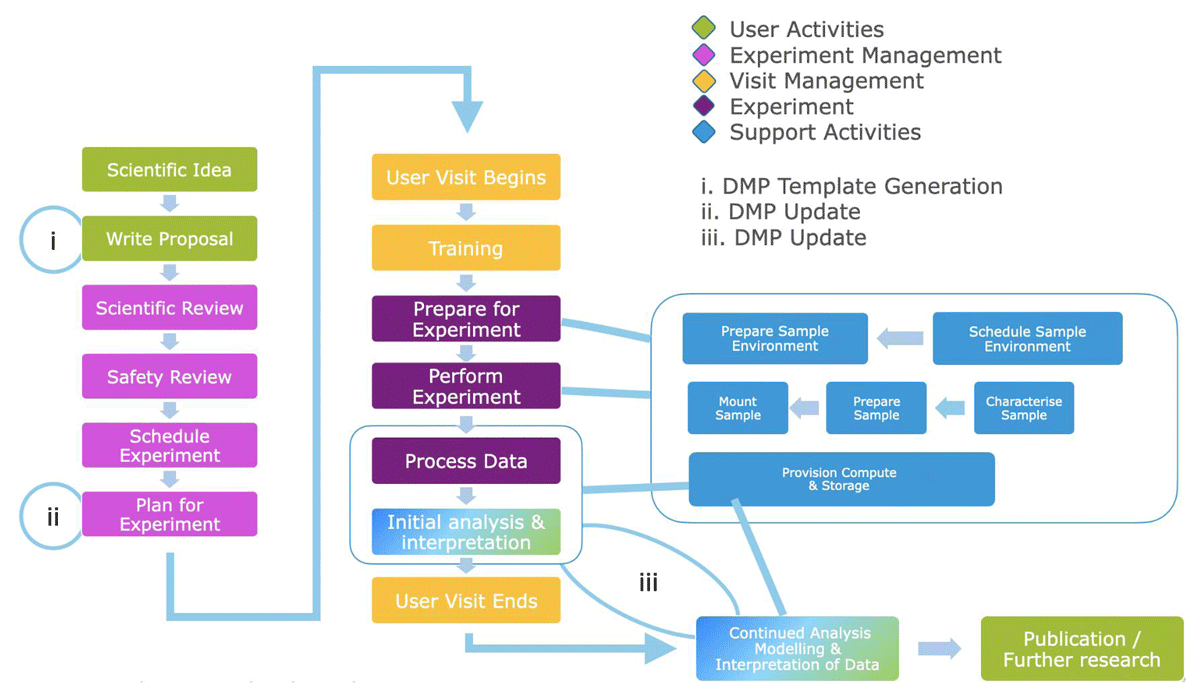
The DMP resulting from this work is based on a knowledge model common to all infrastructures. Consisting of a series of questions, it comprises seven sections and follows the data lifecycle:
- General description of the project and the scientific issues under study
- Description and classification of the datasets. This section details the context of data collection, including a description of the experiment, as well as the raw data obtained, such as data samples, logbooks, files and technical descriptions. It also addresses issues related to data reuse and reproducibility. Can potential users and reuse scenarios be anticipated? Could these datasets be reproduced, and if so, at what cost?
- Data collection. This section specifies the collection conditions (date and volume), the software required to work with the data and the version management procedures.
- Data usage and usage scenarios. This section describes data security and access management, asking questions such as: who modifies the data? Who can access it? How is data security ensured? Who manages backups?); data sharing; and data organisation procedures (are there guidelines for organisation or naming conventions?)
- Metadata and referencing. In this section, the user provides the metadata necessary for understanding and using the data, as well as details on how it was collected (automatically by instruments, semi-automatically, or manually). The user must also describe the data and metadata associated with the analysis (scripts, input files and any auxiliary datasets used), the use of calibration datasets and sample characterisation data.
- Legal and ethical issuesques.
- Data selection and long-term preservation. This section describes the criteria used to select the data to be stored or archived at the end of the project, and justifies the reasons for long-term preservation. Who will have access to the preserved data?
The issue of costs associated with data collection, documentation and preservation is addressed in each relevant section. The DMP must be an ‘active’ document, updated at every stage.
The ESRF Data Management Plan
The « ESRF Data Policy 2024 » is aligned with the FAIR principles. The ESRF Data Management Plan (DMP) is based on the aforementioned knowledge model, adapted to the requirements of the synchrotron (see Bodin et al. 2023). It is automatically generated by the management system six weeks before the launch of the first experiment. Sixty percent of the DMP is automatically populated using internal data sources such as the Data Policy, the ESRF proposal management application, the ICAT metadata catalog, and automatic data collection by instruments. The synchrotron has implemented the DS-Wizard tool (https://ds-wizard.org/), which enables users to respond to the questions that comprise the DMP. The entire document can then be exported in various formats (Horizon Europe templates, ANR, etc., or ESRF format) with pre-filled fields. DMPs for projects created since 2022 can be accessed via a dedicated portal, after authentication. After three years, experiments that are no longer embargoed are freely accessible via the ESRF Data Portal.
How to find examples of DMPs in your field ?
By establishing a working group dedicated to data management plans, RDA France has emphasised the need ‘to take into account the diversity of cultures and disciplinary practices in order to identify relevant examples for a given discipline’ (Analysis and Identification of Disciplinary Data Management Plans That Can Be Used as Examples, Françoise Genova et al., Research Data Alliance France [RDA France]). Françoise Genova et al., Research Data Alliance France (RDA France), 2025). (in french). ⟨hal-05187206v2}).
Based on a methodology for selecting data management plans, the group compiled an initial list of disciplinary plans (Corpus of Disciplinary Data Management Plans that can be used as examples. Françoise Genova et al., 2025, Government Data Research, v1.0, https://doi.org/10.57745/ZSWLYJ).
It includes numerous examples from the earth and environmental sciences, a few from physics and astrophysics, and one from chemical engineering.
While most are project-based data management plans (DMPs), some offer templates or thematic frameworks. One example is the data management plan template from the Paris Observatory: Open Science Working Group at the Paris Observatory (2021). (2021). Data Management Plan Template of the Paris Observatory.
These DMPs are available in the public DMP section on the DMPOpidor drafting platform.
Below is a selection of the DMPs listed.
Physics and astrophysics
The Project Data Management Plan “LOcal Clusters And supercLuster In sZ: Adding Thermal, kInetic and relativistic cOrrectioNs”: https://dmp.opidor.fr/plans/16046/export.pdf?export%5Bquestion_headings%5D=true
Earth and Environmental Sciences
Several PGDs are linked to national observation services (SNO); here is a selection of them (in french) :
- SNO KARST DMP (assessment of the qualitative and quantitative status of water resources in karst hydrosystems) >> https://dmp.opidor.fr/plans/9351/export.pdf?export%5Bquestion_headings%5D=true
- SNO ReefTEMPS DMP – Coastal Water Observation Network in the South, West, and Southwest Pacific Region>>> https://doi.org/10.13155/94550
- SNO DYNALIT DMP – Coastal Dynamics and the Shoreline: https://dmp.opidor.fr/plans/16155/export.pdf?export%5Bquestion_headings%5D=true
- SNO GLACIOCLIM DMP – glacier and snow cover monitoring https://dmp.opidor.fr/plans/23294/export.pdf
- SNO SONEL DMP – Coastal Water Level Monitoring System: https://dmp.opidor.fr/plans/18257/export.pdf?export%5Bquestion_headings%5D=true
- SNO MOOSE DMP -Mediterranean ocean observing system for the environment : https://dmp.opidor.fr/plans/18275/export.pdf?export%5Bquestion_headings%5D=true
Others are infrastructure DMP : the OLA infrastructure DMP, which provides tools and resources (boats, probes, drones, etc.) for exploring lake environments (OLA DMP):: https://doi.org/10.15454/1RUGHK
Others are project DMPs:
- Lautaret Roche Noire Project : https://dmp.opidor.fr/plans/23291/export.pdf?export%5Bquestion_headings%5D=true
- “De la rhéologie à la rupture des plaques tectoniques : de l’affaiblissement à la localisation de la déformation dans le manteau lithosphérique” Project : https://dmp.opidor.fr/plans/13156/export.pdf?export%5Bquestion_headings%5D=true
- “ANR WISPER-Water and Ice-related thermo-mechanical processes in the fractures of Steep alpine bedrock Permafrost” Project https://dmp.opidor.fr/plans/7067/export.pdf?export%5Bquestion_headings%5D=true
- “Theia/OZCAR Information System”Project : https://dmp.opidor.fr/plans/7725/export.pdf?export%5Bquestion_headings%5D=true
- “IMpacts des PRocessus mIcroclimatiques sur la redistributioN de la biodiversiTé forestière en contexte de réchauffement du macroclimat” Project : https://dmp.opidor.fr/plans/5082/export.pdf?export%5Bquestion_headings%5D=true
Chemistry
Among the chemical engineering DMPs, we can highlight:
- ANR EGOUT project- Observations Géochimiques des Trajectoires Urbaines: https://dmp.opidor.fr/plans/13919/export.pdf?export%5Bquestion_headings%5D=true
- “MAgnetic Vesicle Rotation Induced Cell Killing” Project : https://dmp.opidor.fr/plans/6264/export.pdf?export%5Bquestion_headings%5D=true
Accessible via HAL, where data management plans (DMPs) are also available, the Lorraine spectrometry platform MASSLor offers an entity-based DMP integrated with the electronic lab notebook ElabFTW: Frédéric Aubriet, François Dupire, Jasmine Hertzog, Lionel Vernex-Loset. Data Management Plan for the MassLor platform. University of Lorraine; CNRS. 2025. ⟨hal-04895780⟩ (in french)
Conclusion
Some communities have adopted data management plans (DMPs) to promote better shared and documented data management practices, and to produce more FAIR data. However, there are few examples of shared DMPs that exemplify these principles in physics and chemistry.